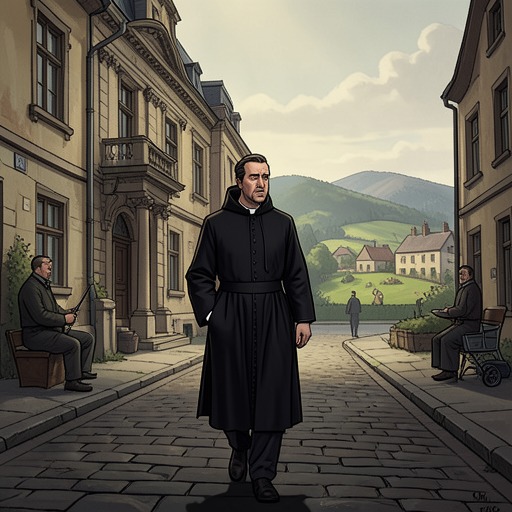
Don Fabrizio and Father Pirrone’s Friendship and Disagreements
The LeopardDon Fabrizio Corbera, Prince of Salina, and Father Pirrone are joined by daily religious practice and the intimacy of a long-standing confessor–penitent relationship, yet they disagree about what should be preserved as Sicily changes. Father Pirrone can rebuke the Prince’s conduct and warn him about the Church’s future; the Prince, in turn, treats the priest as a familiar companion whose seriousness can be met with wit, impatience, and trust. Their bond is neither simple obedience nor agreement: affection and shared habits repeatedly bring them back together after political and moral arguments.
Shared Religious and Private Life
The relationship is embedded in the household’s routine. After the daily Rosary, Don Fabrizio’s steady voice has led half an hour of prayer. The room returns to its usual disorder as the others rise, while Father Pirrone remains absorbed in extra prayer. The contrast establishes their different forms of religious observance: the Prince presides over a family ritual, while the priest continues beyond it, attending to devotion with a discipline of his own.
Their familiarity extends from prayer into confession. When they meet in the observatory, Father Pirrone asks whether the Prince has come to confess. Don Fabrizio initially appears not to remember the previous night’s episode, then responds as though the priest already knows his sins. Father Pirrone rejects the idea that knowledge alone makes confession effective: in his view, the penitent must also feel contrition. His insistence shows that the priest’s role is not merely to hear the Prince but to require him to reckon with the moral meaning of his actions.
A later encounter in the bath makes their private ease comic and physical. After a long, exhausting day, Don Fabrizio is in the bath when Father Pirrone arrives urgently to speak with him. The priest enters as the Prince emerges naked; embarrassed by the sight, he tries to withdraw, but Don Fabrizio orders him to hand over the bathrobe and help him dry. The Prince then recommends that Father Pirrone take a bath himself, turning the usual direction of their advice around: the priest counsels him on morals, while the Prince advises him on hygiene. The scene’s awkwardness does not dissolve their familiarity. Once dressed, Don Fabrizio invites him to sit and explain his haste.
Companionship amid Political Upheaval
During the political crisis, Father Pirrone accompanies Don Fabrizio in a brougham, cramped into a corner and suffering under the Prince’s physical presence and bullying manner. The priest turns his immediate discomfort into reflections on the historical moment. As they look toward the hills around the Conca d’Oro, the rebel bands’ nightly bonfires appear as threats to the city. Don Fabrizio thinks that Tancredi Falconeri might be among the rebels and reproaches himself for failing as his young ward’s guardian. The two men share the journey and its anxieties, though the Prince’s concern is personal and familial while Father Pirrone’s thoughts broaden toward the fate of Church and society.
Their different positions are also visible when Don Fabrizio goes to vote in Donnafugata. Father Pirrone accompanies him but does not cast a ballot, having avoided being registered as a resident. After the Prince votes, Father Pirrone and Don Onofrio Rotolo also decline the offered drink for their separate reasons. The priest is present in the political ritual without taking part in its electoral act, a distinction that reflects his clerical position even as he remains close to the Prince.
Confession, Authority, and Disagreement
At the observatory, the Prince’s political reflections have made him unusually calm. Father Pirrone, still troubled by the previous night’s confession, renews his appeal for Don Fabrizio to confess properly. The Prince’s easy manner initially irritates him, but Father Pirrone eventually offers his hand and acknowledges that he has been too brusque. This gesture breaks the tension: Don Fabrizio begins explaining his political intuitions, and the priest responds not as a distant spiritual authority but as a participant in a candid, familiar argument.
Their disagreement concerns the expected accommodation between the nobility and the Liberals, including the Masons, and the likely cost to the Church. Father Pirrone fears that Church property will be confiscated and divided among ambitious leaders, leaving the destitute who depend on the Church without support. Don Fabrizio answers from the standpoint of a social class that, unlike the Church, has no promise of immortality. He regards adaptation as necessary for the nobility’s survival and admits that his concern does not extend indefinitely into the future. Father Pirrone does not accept the Prince’s reasoning, but long acquaintance with his disillusionment keeps disagreement from becoming a rupture.
The priest even turns the political exchange back toward confession, reminding Don Fabrizio that he has two sins to confess: one of the flesh from the previous day and one of the spirit from that day. The rebuke is pointed but not estranging. Father Pirrone can identify the Prince’s moral evasions while continuing to value his friendship; Don Fabrizio can hear the rebuke without abandoning his own political judgment.
A Working Fellowship
After their argument, the two men resume a shared intellectual pursuit, discussing a report they will send to the observatory at Arcetri. Astronomy offers a field in which their cooperation is less burdened by immediate political interest: they can attend to calculations and the predictable courses of the stars even when the social order around them is unsettled. The return to this work does not resolve their opposing views about the Church, the nobility, or the future. Instead, it shows how a practical companionship can survive disagreement through recurring habits of study and conversation.
Their relationship thus holds together roles that might otherwise pull apart. Father Pirrone is Don Fabrizio’s confessor, a priest who insists on contrition and fears for the Church’s poor; he is also the companion who travels with him, visits him in private, and shares his astronomical interests. Don Fabrizio respects that closeness without submitting his political outlook to it. Their exchanges repeatedly move from ritual to teasing, from moral challenge to political argument, and back to shared work, making their friendship a durable but unresolved negotiation between religious duty and worldly survival.